
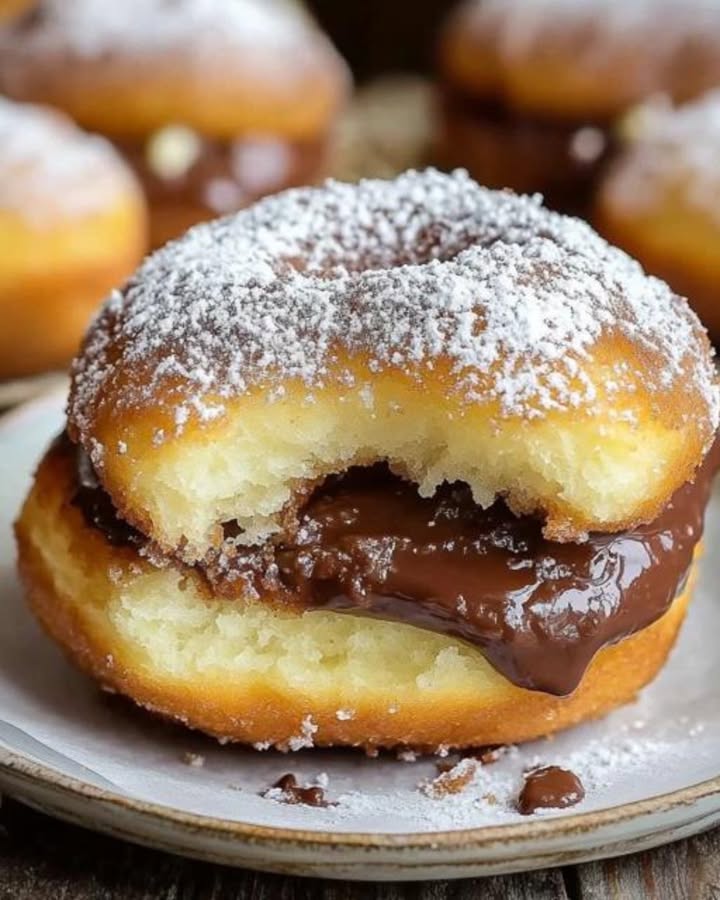
Beignets Gourmands Fourrés au Nutella : Une Bouchée de Bonheur
Vous connaissez ce sentiment quand la journée a besoin d’un petit éclat ? Pour moi, cela implique généralement un beignet tout chaud et un pot de Nutella. La première fois que j’ai préparé ces beignets fourrés au Nutella, ma cuisine sentait la pâtisserie parisienne et les visages de ma famille se sont illuminés de pur plaisir. Il y a quelque chose de magique dans l’instant où l’on croque et où la garniture riche et crémeuse de chocolat-noisette s’écoule. C’est plus qu’un en-cas ; c’est un câlin en version comestible. Oubliez la version achetée en magasin – ces beignets Nutella gourmands faits maison sont incroyablement moelleux, aériens et remplis d’amour (et d’une généreuse quantité de cette fameuse pâte à tartiner).
Un Petit Historique des Douceurs Fourrées
Les donuts, ou beignets comme on appelle certaines versions en France, ont une longue et délicieuse histoire. Ils réconfortent les gens depuis des siècles, évoluant d’une simple pâte frite aux merveilles artisanales d’aujourd’hui. L’idée de les farcir de confiture ou de crème est un classique, mais l’ajout génial du Nutella est une innovation plus moderne et décadente. Ma propre touche à cette tradition est venue de l’obsession de mon fils pour la pâte à tartiner chocolat-noisette – je voulais le surprendre avec une gourmandise extra spéciale. Cette recette associe cette pâte frite réconfortante et traditionnelle à un cœur fondant et moderne. C’est un mariage parfait.
Pourquoi Vous Allez Adorer Ces Beignets au Nutella
Ce ne sont pas des beignets ordinaires. Premièrement, la pâte est incroyablement souple et moelleuse, grâce à une bonne et longue levée. Deuxièmement, le contraste entre l’extérieur tiède et légèrement croustillant et la garniture fraîche et veloutée de Nutella est un véritable paradis des textures. Ils sont aussi étonnamment amusants à préparer ! Il y a une véritable joie à pétrir la pâte, à la regarder gonfler, et la gratification instantanée de la friture. De plus, rien ne vaut le goût d’un beignet fraîchement frit et fait maison. Ils sont parfaits pour tous ceux qui aiment un projet avec une délicieuse et douce récompense à la clé.
Quand Préparer une Fournée de Beignets Gourmands
Ces beignets gourmands transforment n’importe quel moment en célébration. Ils sont parfaits pour un brunch du week-end avec un café, un dessert spectaculaire pour un dîner entre amis, ou la surprise ultime pour les enfants après l’école. J’adore en faire pour les matins d’anniversaire – c’est une tradition amusante qui commence la journée avec le sourire. Ils sont aussi fantastiques pour une journée de pâtisserie douillette « juste parce que », quand le temps est gris et qu’on a besoin de créer son propre soleil (et de délicieux parfums) dans la cuisine.
Rassemblez Vos Ingrédients pour des Beignets au Nutella
Rassemblons les ingrédients simples et sains qui vont se transformer en quelque chose de magique. Utiliser des basiques de bonne qualité fait toute la différence !
- 240 ml de lait tiède (pas chaud, juste agréable au toucher)
- 100 g de sucre en poudre
- 7 g de levure boulangère sèche active (un sachet standard)
- 115 g de beurre non salé, fondu et légèrement refroidi
- 2 gros œufs, à température ambiante
- 1 càc d’extrait de vanille pur
- 500 g de farine tout usage (tamisée)
- 1/2 càc de sel fin
- 300 g de Nutella (ou votre pâte à tartiner chocolat-noisette préférée) pour la garniture
- Huile végétale, pour la friture
Substitutions Simples et Alternatives
Pas d’inquiétude si il vous manque un ingrédient ! Voici quelques alternatives faciles :
- Lait : Tous les laits fonctionnent – entier, demi-écrémé, ou même un lait végétal nature non sucré comme l’amande ou l’avoine.
- Beurre : En cas de besoin, vous pouvez utiliser une quantité égale d’huile végétale.
- Nutella : N’hésitez pas à utiliser une autre pâte épaisse ! La pâte à tartiner spéculoos (Biscoff), une sauce caramel au beurre salé, ou même une bonne confiture épaisse sont des alternatives fantastiques.
- Pas de levure ? Vous pouvez essayer une recette de beignets à la poudre à lever, bien que la texture sera plus proche d’un cake que d’un beignet moelleux et aéré.
Créer Vos Beignets Maison au Nutella : Étape par Étape
Étape 1 : Réveiller la Levure
Dans un grand saladier, mélangez le lait tiède et le sucre. Remuez doucement jusqu’à ce que le sucre commence à se dissoudre. Saupoudrez la levure par-dessus et laissez reposer sans toucher pendant environ 5 à 7 minutes. Vous guettez le miracle : le mélange doit devenir mousseux et crémeux, comme un petit cappuccino. Cette mousse vous indique que la levure est active et vivante, prête à rendre votre pâte légère et aérée. Astuce de pro : Si votre lait est trop chaud, il tuera la levure ; trop froid, et elle ne s’activera pas. Cherchez une température similaire à celle d’un bain chaud.
Étape 2 : Combiner les Ingrédients Liquides
Une fois que votre levure est mousseuse et heureuse, versez le beurre fondu (mais pas chaud), les œufs à température ambiante et l’extrait de vanille. Fouettez le tout jusqu’à obtenir un liquide lisse et jaune pâle. L’arôme sucré de la vanille commencera à se mêler à l’odeur maltée de la levure. Cette combinaison de richesse (beurre et œufs) est ce qui donne aux beignets leur mie tendre et leur saveur riche.
Étape 3 : Former la Pâte
Maintenant, ajoutez la farine et le sel dans le saladier. Si vous utilisez un robot pâtissier, équipez-le du crochet à pétrir et mélangez à vitesse lente jusqu’à ce qu’une pâte hétérogène se forme. Si vous mélangez à la main, utilisez une cuillère en bois robuste. Une fois combinés, augmentez la vitesse (ou sortez la pâte sur un plan fariné) et pétrissez pendant environ 5 minutes. La pâte doit se décoller des parois du saladier et devenir lisse, souple et légèrement élastique au toucher.
Étape 4 : La Première Pousse
Huilez légèrement un saladier propre avec un peu d’huile ou de beurre. Placez votre boule de pâte lisse dans le saladier, en la retournant une fois pour l’enrober légèrement d’huile. Couvrez le saladier hermétiquement avec un film alimentaire ou un torchon de cuisine propre et humide. Trouvez-lui un endroit chaud et sans courant d’air pour reposer. Je la mets souvent dans mon four avec juste la lumière allumée. Laissez lever pendant environ 1 h à 1 h 30. Vous saurez qu’elle est prête lorsqu’elle aura doublé de volume et qu’elle gardera l’empreinte d’un doigt que vous y enfoncez délicatement.
Étape 5 : Façonner les Beignets
Dégazez la pâte levée d’un coup de poing – c’est une étape très satisfaisante ! Sortez-la sur un plan de travail légèrement fariné. Étalez la pâte sur une épaisseur d’environ 1,25 cm. Utilisez un emporte-pièce rond ou le bord d’un verre (d’environ 7,5 cm de diamètre) pour découper des cercles. Rassemblez les chutes, étalez-les délicatement à nouveau et découpez d’autres cercles jusqu’à épuisement de la pâte. Placez les cercles sur une plaque à pâtisserie recouverte de papier sulfurisé, couvrez-les à nouveau et laissez-les lever une seconde fois, plus courte – environ 30 minutes. Ils vont visiblement gonfler.
Étape 6 : Frire jusqu’à Perfection Dorée
Pendant que les beignets font leur dernière levée, versez de l’huile végétale dans une casserole à fond épais ou une friteuse sur une hauteur d’environ 7,5 cm. Chauffez l’huile à 175°C. Utilisez un thermomètre pour plus de précision ; c’est la clé d’une cuisson uniforme. Glissez délicatement quelques cercles de pâte levée dans l’huile chaude à l’aide d’une écumoire. Ne surchargez pas la casserole. Faites frire environ 1 à 2 minutes de chaque côté jusqu’à ce qu’ils soient d’un beau brun doré profond. Les beignets vont encore gonfler pendant la friture. Transférez-les sur une grille posée sur du papier absorbant pour les égoutter et les laisser refroidir complètement avant de les garnir. Astuce du chef : Les laisser refroidir entièrement empêche le Nutella de fondre en un désordre liquide à l’intérieur.
Étape 7 : Garnir avec la Joie du Nutella
C’est la meilleure partie ! Munissez une poche à douille d’une douille longue et étroite (comme une douille à beignet Bismarck). Remplissez la poche avec le Nutella. Une fois les beignets complètement refroidis, insérez délicatement la pointe de la douille sur le côté d’un beignet. Serrez fermement la poche, en injectant le Nutella au centre jusqu’à sentir le beignet s’alourdir légèrement. Vous verrez souvent un peu de garnition dépasser du trou. Répétez avec tous les beignets. Pour une touche supplémentaire, vous pouvez les saupoudrer de sucre glace ou les napper d’un filet de chocolat fondu.
Votre Chronologie vers le Bonheur Beignet
- Temps de préparation : 30 minutes (active)
- Temps de levée : 1 h 30 au total
- Temps de friture : 15-20 minutes
- Garnissage et refroidissement : 20 minutes
- Temps total : Environ 2 heures 45 minutes
- Kcal : Environ 300 par beignet fourré
Le Secret du Chef pour les Beignets les plus Légers
Mon arme secrète ? La patience pendant les levées. Ne précipitez pas les temps de pousse ! Laisser la pâte lever pleinement permet à la levure de créer une multitude de petites bulles d’air, ce qui vous donne cette texture légère comme une plume et aérée, au lieu d’un résultat dense et lourd. La seconde levée, plus courte, juste avant la friture, est tout aussi cruciale pour un gonflement optimal. Toutes les bonnes choses viennent à qui sait attendre – surtout quand il s’agit de pâte à la levure.
Une Anecdote Amusante sur le Nutella
Saviez-vous que la création du Nutella est née de la nécessité ? Après la Seconde Guerre mondiale, le cacao était rare en Italie. Un pâtissier du nom de Pietro Ferrero étira le peu de cacao dont il disposait en le mélangeant avec des noisettes, abondantes dans sa région. Cette pâte ingénieuse est finalement devenue la pâte à tartiner adorée que nous connaissons aujourd’hui. Ainsi, chaque fois que vous garnissez un beignet, vous savourez un petit morceau d’histoire intelligente et délicieuse !
Les Outils Dont Vous Aurez Besoin dans Votre Cuisine
Pas besoin d’appareils sophistiqués, mais ces outils aident beaucoup :
- Grand saladier
- Robot pâtissier avec crochet à pétrir (optionnel mais utile)
- Rouleau à pâtisserie
- Emporte-pièce rond de 7,5 cm
- Plaques à pâtisserie & papier sulfurisé
- Casserole profonde et lourde ou faitout
- Thermomètre de cuisson/pour friture
- Écumoire ou araignée de cuisine
- Grille de refroidissement
- Poche à douille avec une douille longue et étroite (un sac plastique avec le coin coupé fonctionne en dépannage)
Comment Conserver Vos Beignets Maison
Ces beignets fourrés au Nutella sont véritablement meilleurs dégustés le jour même. Le contraste entre l’extérieur croustillant et l’intérieur moelleux est à son apogée. Cependant, il nous arrive à tous d’avoir des restes !
Si vous devez les conserver un jour, rangez-les en une seule couche dans un contenant hermétique à température ambiante. Évitez le réfrigérateur, car il rendra la pâte rassise plus vite. La garniture ramollira légèrement le beignet durant la nuit, mais le goût restera délicieux.
Pour une conservation plus longue, vous pouvez congeler les beignets frits et refroidis, mais non garnis. Disposez-les en une seule couche sur une plaque pour les congeler rapidement, puis transférez-les dans un sac de congélation. Ils se conservent jusqu’à 2 mois. Décongelez à température ambiante et réchauffez-les légèrement au four avant de les garnir et de les servir.
Conseils de Pro pour la Réussite de Vos Beignets
- La Température de l’Huile est Reine : Utilisez un thermomètre ! Une huile trop chaude brûlera l’extérieur en laissant l’intérieur cru. Une huile trop froide rendra les beignets gras et lourds. Ciblez une température stable de 175°C.
- Refroidir Complètement Avant de Garnir : Je ne le répéterai jamais assez. Des beignets tièdes transformeront votre belle garniture au Nutella en un désordre liquide. Attendez qu’ils soient vraiment à température ambiante.
- Pétrir avec Confiance : N’ayez pas peur de bien pétrir la pâte. Cela développe le gluten, qui donne aux beignets leur structure tendre et moelleuse.
- Faire un Test : Avant de frire toute la fournée, testez un petit morceau de pâte ou un trou de beignet pour vérifier la température de l’huile et ajuster votre temps de friture.
Faites-leur Aussi Belle Mine qu’en Bouche
La présentation fait partie du plaisir ! Essayez ces idées :
- Saupoudrez généreusement une pile de beignets de sucre glace pour un look classique et neigeux.
- Versez un filet de chocolat fondu ou de chocolat blanc sur le dessus en forme de zig-zag élégant.
- Roulez les bords dans des noisettes finement hachées et toastées pour un croustillant délicieux qui rappelle la saveur intérieure.
- Servez-les sur un beau présentoir à gâteau avec des fruits rouges frais et une cafetière pour le centre de table d’un brunch.
Six Délicieuses Variations de Recette à Essayer
Vous aimez ce concept ? Voici d’autres façons de satisfaire votre envie de sucré, de notre cuisine à la vôtre.
Si vous adorez le contraste d’une pâte sucrée et d’une garniture riche, vous allez adorer nos Mini Pies Irrésistibles Cerises-Crémeux. Elles offrent cette même expérience merveilleuse de pâtisserie fourrée à manger avec les mains, avec une touche fruitée.
Pour un autre dessert incroyable à étages qui fait toujours l’unanimité, essayez notre Gâteau Carotte Décadent avec son Glaçage Crémeux. Le gâteau épicé et le glaçage crémeux sont un mariage fait au paradis.
Si vous êtes fan de chocolat blanc, vous devez absolument préparer une fournée de nos Brownies fondants au Chocolat Blanc. Ils sont délicieusement fondants et décadents.
Et pour un dessert plus léger, à base de mousse, qui ne nécessite aucune cuisson, notre Délicieux Gâteau Mousse est une option rafraîchissante et élégante pour toute occasion.
Plus de variations amusantes pour vos beignets :
- Cannelle-Sucre : Roulez les beignets tièdes et fraîchement frits dans un mélange de sucre et de cannelle pour un classique intemporel.
- Fourré au Curd de Citron : Remplacez le Nutella par un curd de citron acidulé et brillant pour une surprise pétillante.
- Fourré à la Confiture : Utilisez une confiture épaisse de framboise ou de fraise pour une sensation classique de « beignet à la confiture ».
- Glaçage au Cidre de Pomme : Mélangez du sucre glace avec un trait de cidre de pomme et une pincée de cannelle pour un glaçage inspiré de l’automne.
- Nappé au Chocolat : Trempez le dessus des beignets dans une ganache au chocolat simple et saupoudrez de fleur de sel.
- Style Boston Cream : Garnissez de crème pâtissière à la vanille et trempez le dessus dans un glaçage chocolaté brillant.
Erreurs Courantes à Éviter avec les Beignets Nutella
Erreur 1 : Utiliser du Lait Chaud pour Activer la Levure
C’est l’erreur la plus courante qui peut ruiner votre pâte avant même de commencer. Si le lait est trop chaud (au-dessus de 46°C), il tuera la levure et votre pâte ne lèvera pas du tout. Vous vous retrouverez avec des disques denses et lourds au lieu de beignets moelleux. Testez toujours la température du lait sur l’intérieur de votre poignet – il doit être tiède, pas chaud. Une bonne règle : si vous pouvez y garder votre doigt confortablement, c’est bon pour la levure.
Erreur 2 : Frire dans une Huile à Mauvaise Température
Frire sans thermomètre est un jeu de hasard. Si l’huile est trop froide, les beignets absorberont trop d’huile et deviendront gras et lourds. Si elle est trop chaude, l’extérieur brûlera rapidement tandis que l’intérieur restera cru. Investir dans un simple thermomètre à friture est le meilleur moyen de garantir des beignets parfaits, dorés et parfaitement cuits à chaque fois. Maintenez la chaleur à une température stable de 175°C pour des résultats idéaux.
Erreur 3 : Garnir les Beignets Alors Qu’ils Sont Encore Tièdes
Votre impatience est compréhensible, mais la patience est ici essentielle ! Injecter du Nutella dans un beignet tiède fait fondre immédiatement la matière grasse de la pâte à tartiner. Cela transforme votre jolie garniture en une sauce liquide qui imbibe la pâte, créant un désordre détrempé et rendant le processus de remplissage frustrant. Laissez les beignets refroidir complètement sur une grille. Cela garantit que la garniture reste épaisse et crémeuse à l’intérieur de sa poche moelleuse.
Erreur 4 : Trop Charger la Casserole de Friture
Il est tentant de frire plusieurs beignets à la fois pour gagner du temps, mais c’est contre-productif. En ajouter trop d’un coup fait chuter brutalement la température de l’huile. Cela entraîne une cuisson inégale et des beignets gras. Faites frire par petits lots de 2 à 3 beignets à la fois. Cela permet à la température de l’huile de se rétablir rapidement entre les fournées et assure que chaque beignet a assez d’espace pour gonfler et cuire uniformément sur tous les côtés.
Pour en savoir plus sur la composition de vos ingrédients, y compris les lipides et matières grasses qui contribuent à la texture des pâtisseries, il est utile de consulter des ressources nutritionnelles fiables. Cette connaissance peut vous aider à faire des choix éclairés en cuisine.
Si vous cherchez plus d’inspiration sucrée après avoir maîtrisé ces beignets, n’hésitez pas à explorer toute notre collection de recettes de gâteaux et pâtisseries pour votre prochaine aventure en pâtisserie.
Vos Questions sur les Beignets Nutella, Répondues
Puis-je cuire ces beignets au four au lieu de les frire ?
Vous pouvez certainement essayer de les cuire au four pour une option plus légère, mais la texture sera très différente. Les beignets au four ressembleront plus à un muffin ou un cake – ils n’auront pas cet extérieur croustillant classique et cet intérieur aéré et moelleux que donne la friture. Si vous choisissez de les cuire, graissez un moule à beignets, remplissez les alvéoles aux 2/3 avec la pâte levée, et enfournez à 190°C pendant environ 10 à 12 minutes. Ils seront délicieux, mais c’est une gourmandise distincte de la version frite traditionnelle.
Comment savoir si ma levure est encore active ?
Excellente question ! La meilleure façon de tester une levure qui est dans votre placard est de faire une « preuve ». Diluez une cuillère à café de sucre dans 60 ml d’eau tiède (environ 43°C). Saupoudrez la levure sur l’eau et laissez reposer 5 à 10 minutes. Si elle devient bulleuse, mousseuse et se développe, votre levure est vivante et prête à l’emploi. Si rien ne se passe, la levure est probablement morte et vous aurez besoin d’un nouveau sachet pour continuer la recette. C’est une étape simple qui peut vous économiser des ingrédients et du temps.
Puis-je préparer la pâte à l’avance ?
Absolument ! C’est une astuce fantastique pour gagner du temps. Après la première levée (Étape 4), vous pouvez dégazer la pâte, la placer dans un saladier graissé, la couvrir hermétiquement et la réfrigérer jusqu’à 24 heures. Cette levée lente et froide développe même plus de saveur. Quand vous êtes prêt à continuer, sortez la pâte du frigo, laissez-la reposer à température ambiante environ 30 minutes, puis étalez, découpez et faites la seconde levée comme indiqué. La pâte pourrait mettre un peu plus de temps à gonfler pour la seconde levée puisqu’elle est froide.
Pourquoi mes beignets sont-ils devenus denses et lourds ?
Des beignets denses sont généralement le résultat d’un de ces problèmes : 1) La levure a été tuée par un liquide trop chaud ou était vieille et inactive, donc la pâte n’a pas levé correctement. 2) La pâte n’a pas eu assez de temps pour lever durant l’une ou les deux périodes de pousse. Assurez-vous qu’elle ait doublé de volume dans un endroit chaud. 3) La pâte a été trop travaillée après la seconde levée ou manipulée trop brutalement lors du façonnage, ce qui a chassé toutes les précieuses bulles d’air. Une manipulation douce est clé après que la pâte a levé.
Quelle est la meilleure huile pour frire les beignets ?
Vous voulez une huile avec un point de fumée élevé et un goût neutre. D’excellents choix incluent l’huile végétale, l’huile de colza, l’huile d’arachide ou l’huile de tournesol. Évitez l’huile d’olive ou le beurre, car ils ont des points de fumée plus bas et des saveurs prononcées qui affecteront le goût de vos beignets délicats. Assurez-vous d’avoir assez d’huile dans votre casserole pour immerger complètement les beignets (environ 7,5 cm de profondeur) et faites toujours frire dans une casserole à fond épais pour une répartition uniforme de la chaleur.
Mon Nutella est trop épais pour être mis en poche. Que puis-je faire ?
Si votre Nutella est très ferme (surtout par temps frais), il peut être difficile de le faire passer à travers une douille. Vous pouvez le tiédir légèrement pour le rendre plus fluide. Mettez-le dans un bol allant au micro-ondes et chauffez par impulsions de 10 secondes, en remuant bien entre chaque, juste jusqu’à ce qu’il soit un peu plus souple. Attention à ne pas trop le chauffer, sinon il deviendra liquide. Alternativement, vous pouvez laisser le pot dans un bol d’eau tiède pendant 10 à 15 minutes pour l’adoucir en douceur.
Combien de temps puis-je conserver les beignets garnis ?
Les beignets garnis sont meilleurs consommés dans les 24 heures. L’humidité de la garniture va lentement ramollir la pâte autour. Conservez-les en une seule couche dans un contenant hermétique à température ambiante fraîche. Évitez le réfrigérateur, car il accélère le rassissement. Si vous devez les garder plus longtemps, il est préférable de congeler les disques de pâte façonnés non frits, ou les beignets frits non garnis, et de les garnir le jour où vous prévoyez de les servir.
Puis-je utiliser une autre garniture ?
Bien sûr ! Laissez libre cours à votre créativité. La crème pâtissière épaisse, la crème vanille, le dulce de leche, ou même une compote de fruits sont toutes d’excellentes options. Assurez-vous simplement que votre garniture est assez épaisse pour ne pas fuir. Pour la confiture, choisissez une variété pas trop liquide. Le monde des beignets fourrés est votre terrain de jeu. Personnellement, j’adore un mélange de Nutella et d’une cuillerée de confiture de framboise pour un combo chocolat-fruits rouges.
Ai-je besoin d’une douille spéciale pour garnir les beignets ?
C’est fortement recommandé car cela rend le travail propre et facile. Une douille à beignet Bismarck ou une longue douille de remplissage étroite (comme la Wilton #230) est conçue pour s’enfoncer dans le beignet et déposer la garniture droit au centre. Si vous n’en avez pas, vous pouvez utiliser un petit couteau pointu pour creuser une poche sur le côté du beignet, puis utiliser une petite cuillère ou un sac plastique avec le coin coupé pour le garnir. La douille spéciale vous donne juste un point d’entrée plus professionnel et discret.
Que faire de l’huile de friture restante ?
Ne versez jamais l’huile de cuisson usagée dans l’évier. Une fois l’huile complètement refroidie, vous pouvez la filtrer à travers un tamis fin ou une passoire doublée d’un filtre à café ou d’une étamine pour retirer les résidus. Conservez-la dans un contenant fermé dans un endroit frais et sombre. Vous pouvez la réutiliser pour une autre friture (salée ou sucrée) 2 à 3 fois, tant qu’elle sent encore propre. Lorsque vous avez fini, débarrassez-vous-en en l’apportant à un point de collecte local qui accepte les huiles usagées ou en la scellant dans un contenant non recyclable et en la mettant à la poubelle.
La Dernière Bouchée, la Plus Douce
Voilà – la feuille de route pour créer vos propres beignets fourrés oniriques à la maison. Cela peut sembler être un projet, mais chaque étape est simple, et le processus fait partie du plaisir. Voir ces bouffées dorées sortir de l’huile et partager la joie de cette première bouchée chocolatée vaut chaque minute. Alors, attachez votre tablier, mettez de la bonne musique, et préparez-vous à créer des beignets Nutella gourmands inoubliables. Votre cuisine est sur le point de devenir l’endroit le plus joyeux de la maison. Bonne pâtisserie !
Equipment
- Grand bol de mixage
- Batteur sur socle avec crochet à pâte (optionnel)
- Rouleau à pâtisserie
- Emporte-pièce rond de 7,5 cm
- Plaques à pâtisserie et papier sulfurisé
Ingrédients
- 240 ml lait tiède pas chaud, juste agréablement chaud au toucher
- 100 g sucre granulé
- 7.5 g levure sèche active ou 2 1/4 cuil. à café
- 113 g beurre non salé, fondu et légèrement refroidi
- 2 grands œufs à température ambiante
- 5 ml extrait de vanille
- 500 g farine tout usage mesurée et nivelée
- 2.5 g sel fin
- 250 g Nutella ou votre pâte à tartiner chocolat-noisette préférée
- 500 ml huile végétale pour la friture
Instructions
- Dans un grand bol, combinez le lait tiède et le sucre, et remuez doucement jusqu'à ce que le sucre commence à se dissoudre.
- Saupoudrez la levure sur le dessus et laissez reposer pendant 5 à 7 minutes jusqu'à ce que le mélange devienne mousseux.
- Ajoutez le beurre fondu, les œufs et l'extrait de vanille dans le bol et mélangez jusqu'à obtenir un liquide lisse.
- Incorporez la farine et le sel, puis pétrissez la pâte pendant environ 5 minutes jusqu'à ce qu'elle soit lisse et légèrement élastique.
- Graissez légèrement un bol et placez-y la pâte, couvrez avec un film plastique et laissez lever dans un endroit chaud pendant 1 à 1,5 heures jusqu'à ce qu'elle double de taille.
- Lorsque la pâte a levé, abaissez-la sur une surface fariné à environ 1,5 cm d'épaisseur et coupez des cercles avec un emporte-pièce de 7,5 cm.
- Placez les cercles sur une plaque recouverte de papier sulfurisé, couvrez et laissez lever à nouveau pendant environ 30 minutes.
- Faites chauffer l'huile à 175°C dans une grande casserole et faites frire les beignets quelques-uns à la fois pendant 1-2 minutes de chaque côté jusqu'à ce qu'ils soient dorés.
- Transférez les beignets sur une grille pour qu'ils refroidissent complètement.
- Une fois refroidis, remplissez chaque beignet avec du Nutella à l'aide d'une poche à douille.
Notes
Nutrition

Je suis Céline, une véritable passionnée d’ustensiles et de matériel de cuisine ! J’adore tester, comparer et découvrir les meilleurs équipements pour rendre la cuisine plus efficace et agréable. Que ce soit un bon couteau, un robot performant ou une poêle incontournable, je suis toujours à la recherche des outils qui feront la différence. Mon but est de vous guider dans vos choix pour que vous ayez le bon matériel adapté à vos besoins.